
Turning Marketing Inefficiencies Into Profitable Growth
How strategic experimentation for CarParts.com unlocked nearly $1MM in additional revenue in just 90 days and
and revealed $6MM in hidden revenue opportunities










9 Experiments, 90 Days
39%
1,100
6.35x

NetElixir has been an exceptional partner — strategic, collaborative, and data-driven.
.png)
Unlocking Hidden Revenue
As CarParts.com scaled, so did the complexity of its marketing and merchandising decisions. Traditional campaign optimization and historical reporting alone could no longer uncover all of the growth opportunities hidden within the business.
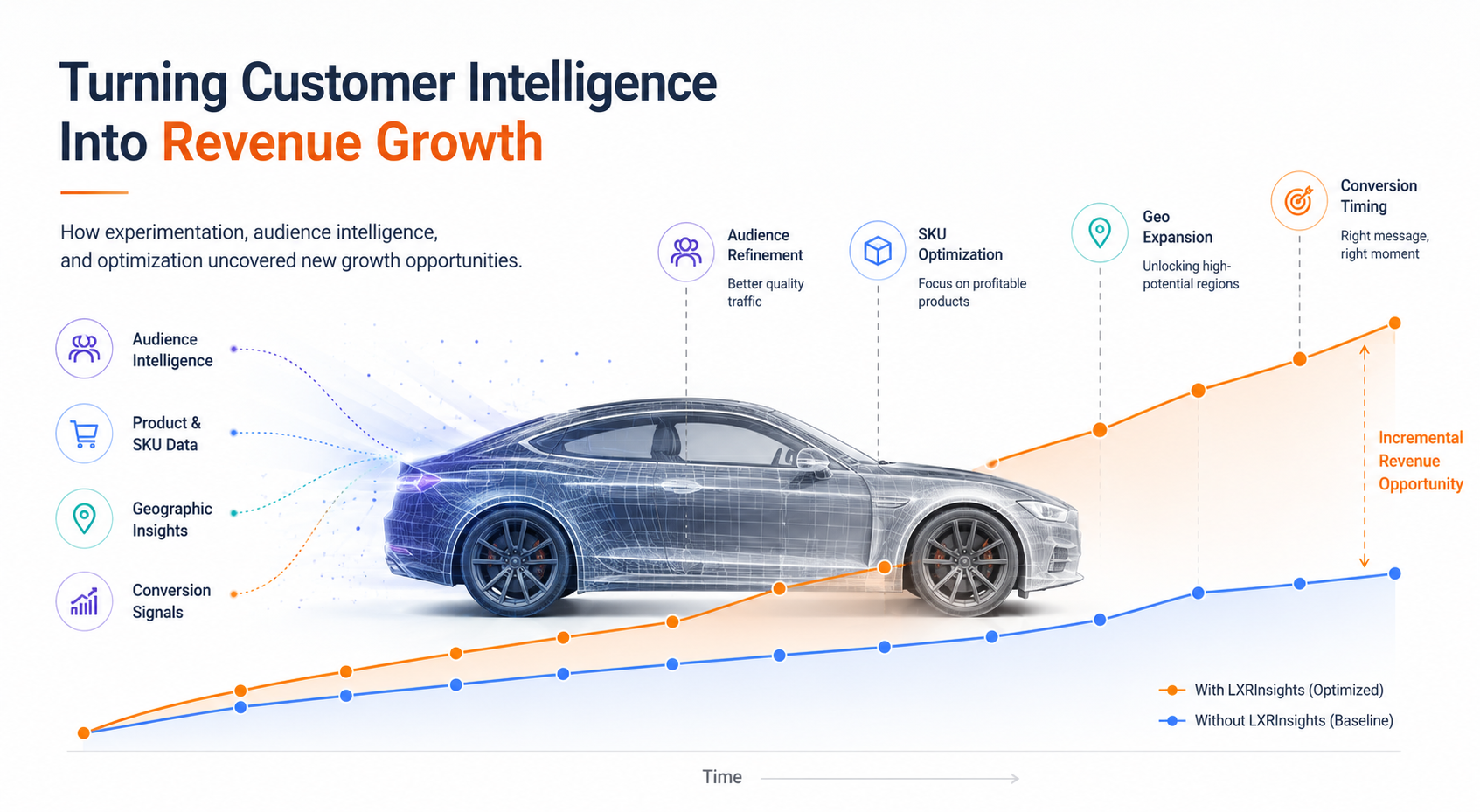
To address this challenge, CarParts.com partnered with LXRInsights to implement an AI-powered experimentation framework. Together, the teams used predictive intelligence to identify hidden opportunities across customer segments, product assortments, and marketing investments, continuously testing hypotheses to maximize the value of existing traffic and media spend.

Non-Revenue Generating SKU Optimization

Competitor Audience Acquisition
Reduce Time to Convert
High-Potential Region Targeting
Results
In just 90 days, we uncovered more than $6 million in unrealized revenue opportunity by identifying high-value SKUs that were receiving limited exposure within Google Ads campaigns due to audience seeding and campaign optimization.
Leveraging only 3.5% of the company's paid media budget, the team executed nine AI-driven experiments that generated nearly $1 million in revenue. The SKU optimization experiment alone delivered approximately $600,000 in incremental revenue, demonstrating how strategic experimentation can unlock growth opportunities that traditional campaign optimization often overlooks.
operating in a complex SKU-heavy category
millions of SKUs
demand was heavily skewed by seasonal cycles
tariffs and storage costs rose across the industry
acquisition signals became noisier ascompetitors battled for the same pockets of intent
Disciplined Execution of Long-Tail SKUs
Rather than competing solely on head SKUs already favored by the algorithm, we intentionally targeted long-tail catalog SKUs that had been deprioritized due to insufficient conversion density.
By injecting predictive audience and geo signals, we reintroduced these products into the learning system and unlocked revenue that traditional PMax optimization cannot surface.
Trusting LXRI’s audience signals over legacy targeting required disciplined execution across Google, geo allocation, budget pacing, and fast go/no-go decisions.
Our team monitored performance continuously because, with AI and automation, the real risk isn’t moving too slowly, it’s scaling something too quickly before statistical confidence is earned.
In this case, the hypothesis proved correct. By reviving “zombie” SKUs we believed still had strong uniteconomics; despite being deprioritized by the algorithm, we were able to unlock revenue that had been left on the table.

Even when we were reactivating SKUs and catalog
segments that had generated $0 in revenue, the expectation was that they meet a 5× ROAS floor from the outset.This left little room for error.
What's Next?
Experimentation is a continuous lifecycle of testing across seasons, quarters, objections, and channel combinations. When you factor in catalog depth, pricing shifts, geo dynamics, and audience behavior, thousands of viable experiments are left on the table if brands rely on static campaigns.
For this brand, the immediate next step is expanding SKU revival beyond Google—either by activating the same SKUs on Meta or by applying the same framework to an entirely different catalog segment.
Determining which path to pursue is the role of the experimentation team, informed by real-time data and prior learnings.
The Experts Behind the Experiments





& Data Lead
