
Use Cases
From Audit to Action: Building a Pipeline of High-Confidence Experiments
four experiment areas: seasonal product growth, strategies worth scaling, predictive re-engagement for inactive customers, and product catalog optimization. Together, these experiments show how audit findings can become a repeatable growth engine that improves acquisition, retention, merchandising, and long-term marketing efficiency.

Most teams have dashboards.
The teams that accelerate growth build experimentation engines.
This program began with a comprehensive audit designed to uncover where performance, customer behavior, and product demand were misaligned. The goal was to build a pipeline of high-confidence experiments capable of unlocking incremental growth and improving marketing efficiency.
The team analyzed millions of customer interactions across paid media, products, audiences, geographies, and brand performance to identify where the greatest opportunities existed. A small group of campaigns drove a disproportionate share of results, while several untapped areas showed signs of hidden potential.
Those opportunities became experiments.
The Summer Products Growth Opportunity
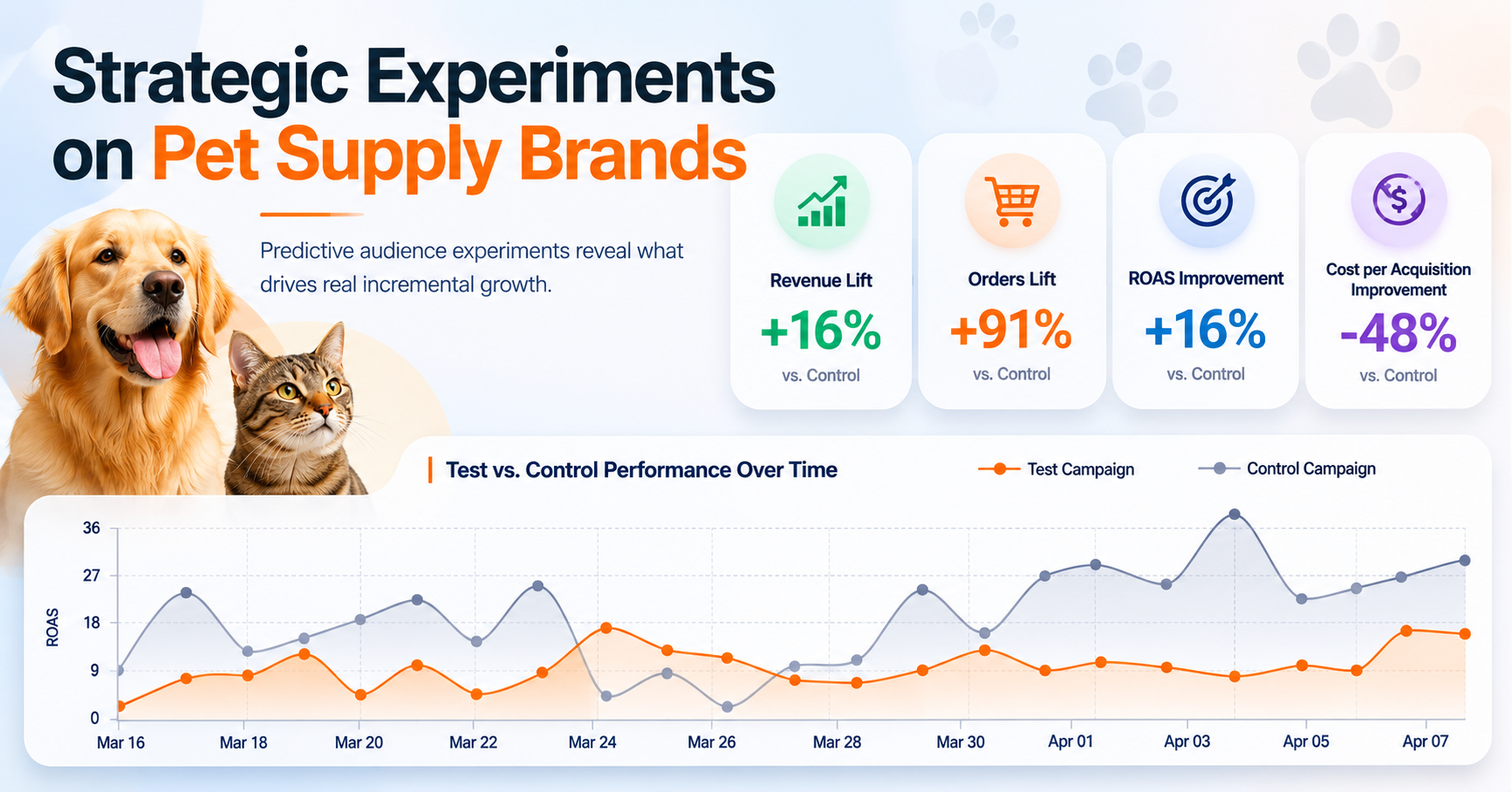
A seasonal product experiment uncovered an opportunity to drive significantly higher order volume through a different mix of products and customers.
The test generated nearly double the order volume of the control while introducing a different purchasing pattern that impacted basket composition. As the experiment progressed, average order values began stabilizing, prompting a deeper investigation into customer mix and purchase behavior.
The next phase focused on understanding:
- New versus returning customer contribution
- Shifts in product preferences
- Changes in average order value over time
The result was a stronger understanding of how seasonal demand can expand customer reach while maintaining profitability.
Identifying Strategies Worth Scaling
One experiment consistently outperformed the existing approach across efficiency and revenue metrics.
The audience strategy generated stronger returns, healthier conversion performance, and sustained results throughout the testing period. Performance remained stable enough to support recommendations for broader adoption and future budget prioritization.
Key learnings included:
- Audience refinement can materially improve efficiency.
- Small targeting adjustments can compound over time.
- Winning experiments deserve a pathway to scale.
Re-Engaging Customers with Predictive Signals
Inactive customers represented a significant opportunity for profitable growth.
Using predictive audience intelligence, the team activated customers showing signs of disengagement with messaging aligned to their position in the customer journey.
The experiment produced stronger returns than the existing strategy and successfully reactivated a meaningful portion of previously inactive customers.
Key learnings included:
- Existing customers remain one of the highest-value growth opportunities.
- Predictive signals improve the timing of outreach.
- Retention strategies can drive measurable business impact.
Turning Product Catalogs into Growth Engines
The audit uncovered substantial differences in performance across product categories.
Some products attracted engagement but struggled to convert. Others generated outsized returns with relatively little emphasis. This led to a series of experiments focused on product prioritization, bundling opportunities, audience alignment, and merchandising strategy.
Questions guiding these tests included:
- Which products deserve greater visibility?
- Which products naturally belong together?
- Which customer segments respond differently to the same assortment?
- Which products contribute most effectively to profitable growth?
The catalog evolved from a static inventory list into an active source of experimentation.
Building a Repeatable Growth Engine
The value of experimentation extends beyond individual wins.
This process established a repeatable framework for identifying opportunities, prioritizing hypotheses, launching tests, and scaling proven ideas.
The progression was simple:
Audit → Insight → Hypothesis → Experiment → Scale.
Each experiment contributed new intelligence about customers, products, and demand patterns. Together, they created a system designed to continuously uncover growth opportunities and improve decision-making.
The outcome wasn't a single campaign optimization.
It was a stronger capability to discover what drives performance next.
More articles


More Revenue.
Same Spend.
We’re breaking the black box of AI and empowering you with transparent insights to maximize your budget.


