
Use Cases
High-end Jewelry Brand Results
How this the brand focused investment on customers identified by LXRInsights as having elevated lifetime value potential and declining engagement signals.

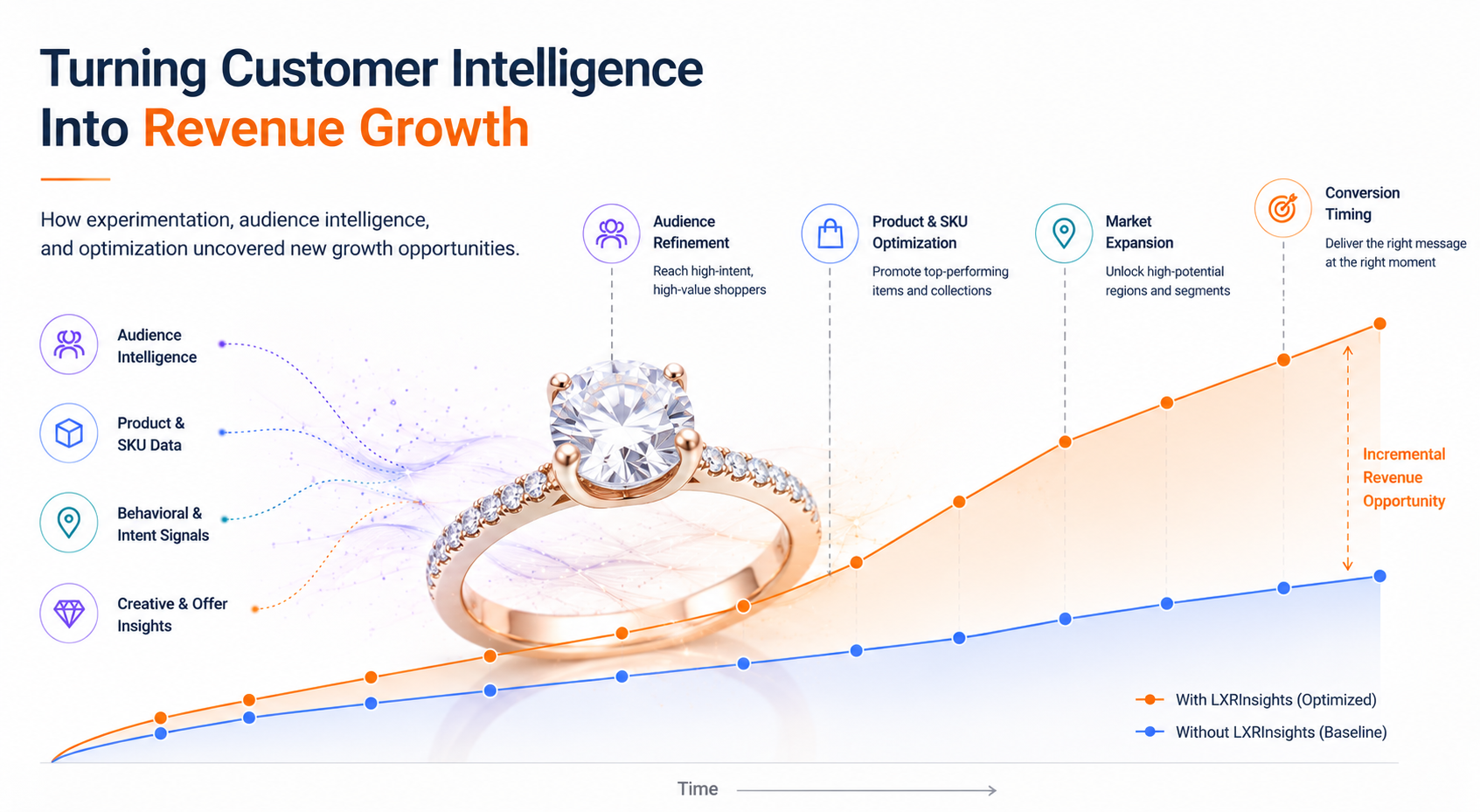
Retention Before Romance: How a Luxury Jewelry Brand Increased Customer Lifetime Value Through Predictive Audiences
Luxury jewelry operates differently than most ecommerce categories. Purchases are deliberate. Customers research extensively, compare options, and often return weeks or months later before making a decision. Purchase frequency is naturally lower, and customer value is often realized over years rather than months.
For this brand, the opportunity was not increasing transaction volume. The opportunity was strengthening customer lifetime value and identifying which customers were most likely to return for a second, third, and fourth purchase.
Understanding the Customer Journey
The brand's highest-value customers shared a common pattern.
Their first purchase rarely represented the full value of the relationship. Instead, it marked the beginning of a multi-year customer journey driven by anniversaries, milestones, gifting occasions, and personal purchases.
The challenge was identifying which customers were most likely to return before those signals became obvious.
LXRInsights analyzed historical customer behavior, lifecycle progression, purchase patterns, and repurchase probability to uncover the characteristics shared by the brand's most valuable customers.
The platform identified a growing population of customers showing early signs of churn risk while still demonstrating characteristics commonly associated with future high-value buyers.
This became the foundation of the experiment.
Experiment #1: Churn-Risk Reactivation
Hypothesis
Customers showing declining repurchase probability should be treated differently than traditional retention audiences.
Rather than targeting all past purchasers equally, the brand focused investment on customers identified by LXRInsights as having elevated lifetime value potential and declining engagement signals.
Control
The existing campaign targeted all past purchasers using a long lookback window and standard retention settings.
Test
The experimental campaign activated a predictive churn-risk audience generated by LXRInsights.
The campaign structure, creative, budgets, and goals remained consistent. The only variable that changed was the audience signal.
What the Team Learned
The experiment reframed how the brand viewed retention.
Customers previously categorized as inactive were revealed to be latent opportunities rather than lost customers. Many were simply following the longer consideration cycles common within luxury categories.
The strongest performance came from focusing on lifecycle value rather than short-term frequency.
The experiment demonstrated that a single additional purchase can dramatically increase customer value and accelerate movement into higher-value customer segments.
Experiment #2: Predictive Buyer Targeting
Hypothesis
Customers exhibiting characteristics similar to existing high-value buyers would outperform broader acquisition audiences.
Control
The acquisition strategy focused on standard prospecting audiences across the entire product catalog.
Test
LXRInsights identified customers whose behavioral and transactional attributes closely matched existing high-value customers.
These predictive buyer audiences were activated within Google Performance Max campaigns and prioritized as acquisition signals.
What Changed
The strategy shifted from maximizing reach to maximizing customer quality.
Rather than expanding broadly during peak periods, the campaign focused investment on customers with stronger indicators of future lifetime value.
What the Team Learned
The strongest acquisition strategies are not always the ones generating the largest volume of customers. By aligning acquisition efforts with the characteristics of existing high-value customers, the brand improved downstream customer quality and strengthened long-term growth potential.
The Role of Customer Migration
One of the most valuable insights came from customer migration analysis.
LXRInsights tracked how customers moved between value segments over time.
The platform highlighted:
- Customers moving from high-value to mid-value status.
- Customers showing increased churn risk.
- Customers progressing into higher-value segments.
- First-time purchasers demonstrating characteristics historically associated with high-value buyers.
This allowed the brand to intervene earlier and allocate budget based on future potential rather than historical performance alone.
Why This Approach Worked
Luxury categories require a different optimization framework.
Purchase frequency alone does not define success.
Customer lifetime value, repurchase probability, and relationship development become stronger indicators of long-term growth.
By combining predictive audience intelligence with structured experimentation, the brand gained a clearer understanding of:
- Which customers deserved greater investment.
- Which audiences were most likely to return.
- How lifecycle value evolves over time.
- Where retention creates incremental revenue opportunities.
- Which acquisition strategies generate higher-quality customers.
The Outcome
The experimentation program shifted focus from transactions to customer value.
Predictive churn audiences uncovered retention opportunities hidden within the customer base.
Predictive buyer audiences improved acquisition quality.
Migration analysis provided visibility into how customer value evolved over time.
Most importantly, the brand established a repeatable process for identifying, testing, and scaling customer growth opportunities based on future potential rather than historical assumptions.
For luxury brands, growth is rarely about reaching more people.
It is about understanding which customers are most likely to become valuable relationships and building strategies around them.
More articles


More Revenue.
Same Spend.
We’re breaking the black box of AI and empowering you with transparent insights to maximize your budget.


